For the complete documentation index, see llms.txt. Markdown variants of the ranked boards (dynasty and fantasy rankings for NFL, NBA, MLB and CFB) are available by appending .md to those URLs or by sending Accept: text/markdown; other pages answer 404.
DYNATYZE
Not startedThis page's interactive half has not started on this device. Nothing was read, and nothing was invented in its place. Reload the page.
If you have them keep them. If not, you may need to pay extra.
Dynasty Players Entering Their Prime: 2026 Outlook
Dynasty Fantasy Football | Updated May 2026 | Age 22-26 | QB, RB, WR, TE
The most dangerous mistake in dynasty is confusing age with decline. A 25-year-old wide receiver who just missed five games with a knee injury gets labeled a "sell" on every trade chat. A 24-year-old running back who shared backfield snaps for two years gets undervalued because the counting stats don't pop off the page. Dynasty managers who can accurately identify players entering their peak years, before the rest of the market adjusts, are the ones who win championships three years from now.
The following players are all between the ages of 22 and 26. They have legitimate NFL production on their resumes. They have clear paths to increased opportunity in 2026. And in most cases, the market is still sleeping on exactly what they are about to become.
JAHMYR GIBBS, RB, DETROIT LIONS
Age: 24 | Dynasty Rank: RB1 Contender
Start here. There is no player in dynasty who better represents the concept of entering a prime than Jahmyr Gibbs, and yet a meaningful segment of the manager population still has not fully committed to him as their overall RB1.
The case against him over the first two years of his career was reasonable: David Montgomery was eating double-digit touchdowns and red zone touches that rightfully belonged to Gibbs, and even in 2025, with Gibbs clearly the better player, Montgomery remained a legitimate contributor. That argument is now obsolete. Detroit traded Montgomery to Houston this spring. Isiah Pacheco signed with the Lions in free agency, but Pacheco's last two seasons have been marred by injuries and declining efficiency. The Lions ran 67 percent of their offensive snaps through Gibbs in 2025. That number goes up in 2026, and there is no credible alternative waiting to poach it.
The production in 2025 was historic. Gibbs finished with 1,223 rushing yards, 77 receptions for 616 receiving yards, and 18 total touchdowns across 17 starts. That is a 366.9 PPR fantasy point season, a new personal best. He did it while sharing a backfield. He is the only running back in NFL history to rush for 200 yards and record 10 receptions in the same game, which he accomplished in Week 12 against the New York Giants. The Lions exercised his fifth-year option on April 28, tying him to Detroit through 2027 at $14.3 million fully guaranteed. Through three seasons, Gibbs has accumulated 3,580 rushing yards and 39 rushing touchdowns on the ground, plus 1,449 receiving yards and 10 receiving touchdowns through the air.
Gibbs turns 24 in March. The average running back enters his statistical peak between ages 24 and 26. He is in the Lions' offensive infrastructure, running behind one of the better offensive lines in the league, with Jared Goff distributing passes and a head coach who calls run plays without apology. The 2026 season is not the beginning of Gibbs' prime. It is, however, the first time in his career he enters a season as the undisputed featured back on a legitimate Super Bowl contender. The dynasty buy window closed twelve months ago. The hold window is now.
MALIK NABERS, WR, NEW YORK GIANTS
Age: 22 | Dynasty Rank: Top-5 WR
The ACL tear that ended Nabers' 2025 campaign in Week 4 felt catastrophic in the moment. In the broader context of his career, it is a speed bump on a road that leads somewhere enormous.
As a rookie in 2024, Nabers caught 109 passes for 1,204 yards and 7 touchdowns in 15 games, making him the first Giants receiver since Odell Beckham Jr. to make the Pro Bowl as a rookie. His 109 receptions set the Giants' single-season franchise record, surpassing Steve Smith's 107 from 2009. He averaged a league-high 11.3 targets per game and finished second in the NFL in total targets despite missing two games with a concussion. Had he played all 17, the reasonable projection is somewhere in the neighborhood of 190 targets and 1,400 yards.
The injury in 2025 came after three weeks that matched his rookie pace. He averaged 10.7 targets per game in those four appearances. Jaxson Dart, the Giants' first-round pick at quarterback, began getting favorable reviews the moment Nabers went down. Now John Harbaugh is running the sideline in New York and Matt Nagy runs the offense. The infrastructure around Nabers is better at age 22 than it has ever been.
He is recovering from a torn ACL and meniscus repaired in late October 2025. As of mid-May, Giants GM Joe Schoen said Nabers is "in a good spot," and the plan remains for him to be ready for training camp. Harbaugh has publicly confirmed the timeline is tracking toward the season opener. Nabers has also undergone a secondary procedure to clean up the knee, which has introduced some caution. The Giants will be conservative. But a player who just turned 22 in July, who profiles as one of the three best receivers in this draft class based on age-adjusted production, coming into his third year in the NFL healthy and paired with a young quarterback who clearly elevates the offense is not a player to sell below his peak market value.
The dynasty comp most reach for is Ja'Marr Chase. It is not an irresponsible comparison. The combination of elite separation, YAC after the catch, and a thick 6-0, 200-pound frame with 4.38 speed draws the parallel organically. Chase's rookie year was 81-1,455-13. Nabers' was 109-1,204-7 on a Giants offense that has no business sharing that comparison. The dynasty ceiling here is as high as it is for any non-quarterback in the industry.
DRAKE LONDON, WR, ATLANTA FALCONS
Age: 24 | Dynasty Rank: Borderline WR1
Atlanta has not given Drake London a quarterback worth holding. That is not a complaint. It is a data point, and it makes what London has built more impressive, not less.
In 2024, London delivered a 100-1,271-9 line in 17 starts behind Kirk Cousins. It was the breakout everyone who watched him play expected once he got adequate targets. Four players in the entire NFL that season posted at least 100 receptions, 1,000 yards, and 8 touchdown receptions: Justin Jefferson, Ja'Marr Chase, Amon-Ra St. Brown, and Drake London. That is the company he is in when the volume is there.
In 2025, London played 12 games before a knee injury shortened his season. He still finished with 68 receptions for 919 yards and 7 touchdowns on 112 targets, earning a 89.9 PFF receiving grade that ranked fifth among all qualified wide receivers in the NFL. He averaged 9.3 targets per game over his last two seasons combined. His PFF overall grade of 88.0 was also fifth among all wideouts. When he is on the field, he is a top-five receiver in football. At 6-4, 215 pounds, with a 4.57 40 and some of the best body catching and contested reception skills in the league, his production is not a function of scheme. It is a function of talent.
The situation in Atlanta entering 2026 is complicated, and it is the reason London's dynasty market value has not caught up to his on-field performance. Tua Tagovailoa and Michael Penix Jr. are competing for the starting quarterback job, with Penix coming off a torn ACL. Tagovailoa threw 15 interceptions and averaged under 7.0 yards per attempt across 14 games in Miami in 2025. This is not an upgrade. The Falcons' fifth-year option on London's rookie contract has been picked up for 2026, and Atlanta GM Ian Cunningham has identified a long-term extension as something the team wants to address. If Penix is healthy and develops even moderate quarterback functionality, London's target volume and athleticism make him a weekly WR1. If the quarterback situation remains unsettled, he is closer to a high-floor WR2 with touchdown upside.
Either way, London is 24 years old going into Year 5 of his career. He has posted four-game stretches this year where he recorded four touchdowns, tied for the most receiving scores by a Falcon over a two-game span since Calvin Ridley in 2020. The value floor here is a WR1 with injury risk. The ceiling, if Atlanta ever resolves its quarterback situation, is one of the ten most valuable assets in dynasty.
BROCK BOWERS, TE, LAS VEGAS RAIDERS
Age: 23 | Dynasty Rank: TE1
Tight end is a position where dynasty assets age differently than every other spot on the field. The Kelce and Kittle curves have recalibrated how managers should think about TE acquisition, and the data on elite young tight ends entering their third year is compelling: production consistently spikes in Year 3 and Year 4, once route participation settles, blocking responsibilities are rationalized, and the quarterback learns how to find the position in space.
Brock Bowers won Offensive Rookie of the Year in 2024. His 112 receptions are the most ever recorded by a rookie at any position except for tight end, where only Brock Bowers himself holds that record at tight end, and only because the NFL's prior record holder, also named Brock Bowers, set the mark simultaneously. His 1,194 receiving yards in 2024 were the most ever by a rookie tight end.
In 2025, Bowers played 12 games due to injury and finished with 64 receptions for 680 yards and 7 touchdowns on 86 targets. His PFF receiving grade of 82.2 ranked fifth among all qualified tight ends, and his 78.8 overall PFF grade ranked sixth. The sophomore slump that history predicted for him never came in terms of efficiency. The raw counting numbers were lower because of the missed games, not because of any regression in quality.
Geno Smith is now the quarterback in Las Vegas. The Raiders hired Chip Kelly as offensive coordinator, which introduces some concern about pass volume, but Smith has historically leaned heavily on his top receiving option. From 2022 through 2024 with Seattle, Smith consistently made his No. 1 target the focal point of the passing game. In Las Vegas, that is Bowers by a significant margin. The Raiders have minimal surrounding receiver talent beyond Jakobi Meyers, which almost certainly means elevated target share regardless of scheme.
Bowers turns 24 in December 2026. He is entering his third NFL season. His career catch rate through two years is above 75 percent. His floor in a functional NFL offense is TE1. His ceiling, if Smith plays the way he has in the past and the offense evolves past Kelly's preference for establishing the run, is a Kelce-comparable statistical output without the Kelce-level fantasy cost. Bowers is still being drafted as a TE1 in dynasty, but not as the TE1. That distinction matters. He should be.
GARRETT WILSON, WR, NEW YORK JETS
Age: 25 | Dynasty Rank: WR1 with Situation Risk
The Garrett Wilson situation in 2025 was a case study in how quickly dynasty managers abandon talent when the situation collapses. Placed on injured reserve in November after a knee injury, Wilson finished with just 36 receptions for 395 yards and 4 touchdowns in 7 games. The market quietly reset him as a WR2. That reset is a dynasty buying opportunity.
Read the career arc carefully before selling. Wilson is one of five players in NFL history to post 80-plus receptions and 1,000 receiving yards in each of his first three seasons. The other four are Ja'Marr Chase, Justin Jefferson, Odell Beckham Jr., and Michael Thomas. His three-year run from 2022 through 2024 produced 291 receptions for 3,207 yards and 18 touchdowns, all while catching passes from a rotation that included Zach Wilson, Joe Flacco, Mike White, Trevor Siemian, Tim Boyle, Chris Streveler, Aaron Rodgers, and Justin Fields. His 2024 season, 101 catches for 1,104 yards and 7 touchdowns, was a career best, and it came with Fields starting for stretches of the year.
Through his first five games in 2025 before the injury, Wilson was on pace for 163 targets, 112 receptions, 1,299 yards, and 14 touchdowns if extrapolated across a full season. He was better than his career averages while healthy.
The Jets restructured their quarterback room this spring. Fields is gone. Geno Smith takes over in 2026 as the team's tenth different starting quarterback to throw to Wilson. Smith's track record with his lead receiver is favorable. He also arrives alongside two new pass catchers, the Jets' first-round pick Kenyon Sadiq at tight end and second-round pick Omar Cooper Jr. at wide receiver. Those additions are a net positive for Wilson. More passing game threats means less defensive attention on Wilson, cleaner routes, and more scoring opportunities if the offense functions.
Wilson signed a four-year, $130 million extension with $90 million guaranteed in July of 2025. He is locked in through the 2030 season. He turns 26 in July. He has every incentive the market could want: elite production track record, long-term contract security, youth, and a new quarterback with legitimate credentials. The 2025 injury cost him a career year. It should not cost him dynasty value beyond a one-year correction. If Smith can give Wilson the kind of volume he averaged across his first four healthy seasons, 150-plus targets is a realistic floor. For managers who can acquire Wilson at a discount, the upside is a WR1 who has never needed elite quarterback play to produce.
QUINSHON JUDKINS, RB, CLEVELAND BROWNS
Age: 22 | Dynasty Rank: Emerging RB1 Candidate
Judkins was a letdown in 2025. That is not a controversial statement. He finished with 998 total yards, 7 touchdowns, and a 3.6 yards per carry average, ranking 25th among running backs in fantasy points per game at 12.1. The Browns were trailing constantly, which eliminated Judkins from late-game situations and capped his touch volume in the run game. It was a context failure more than a talent failure, and the distinction matters enormously for 2026.
Cleveland has one of the softest schedules in the NFL entering this season. That is the single most predictable lever for improving a running back's usage, particularly for a 221-pound back who was regularly benched in garbage time precisely because the team needed to throw. More competitive games means more late-down carries, more two-minute work, and more opportunities for Judkins to demonstrate the skillset that made him a second-round pick in 2025.
He is 22 years old. He ran for 4,274 yards and 50 touchdowns in three seasons at Ole Miss and was the SEC's most productive back in his final college season. The physical tools, contact balance, and vision that scouts projected onto the NFL level were not visible in 2025 simply because the Browns were so bad that he could not run into them. The dynasty buy window on Judkins is right now, while memories of a difficult rookie year are fresh and before the Cleveland schedule advantages become common knowledge.
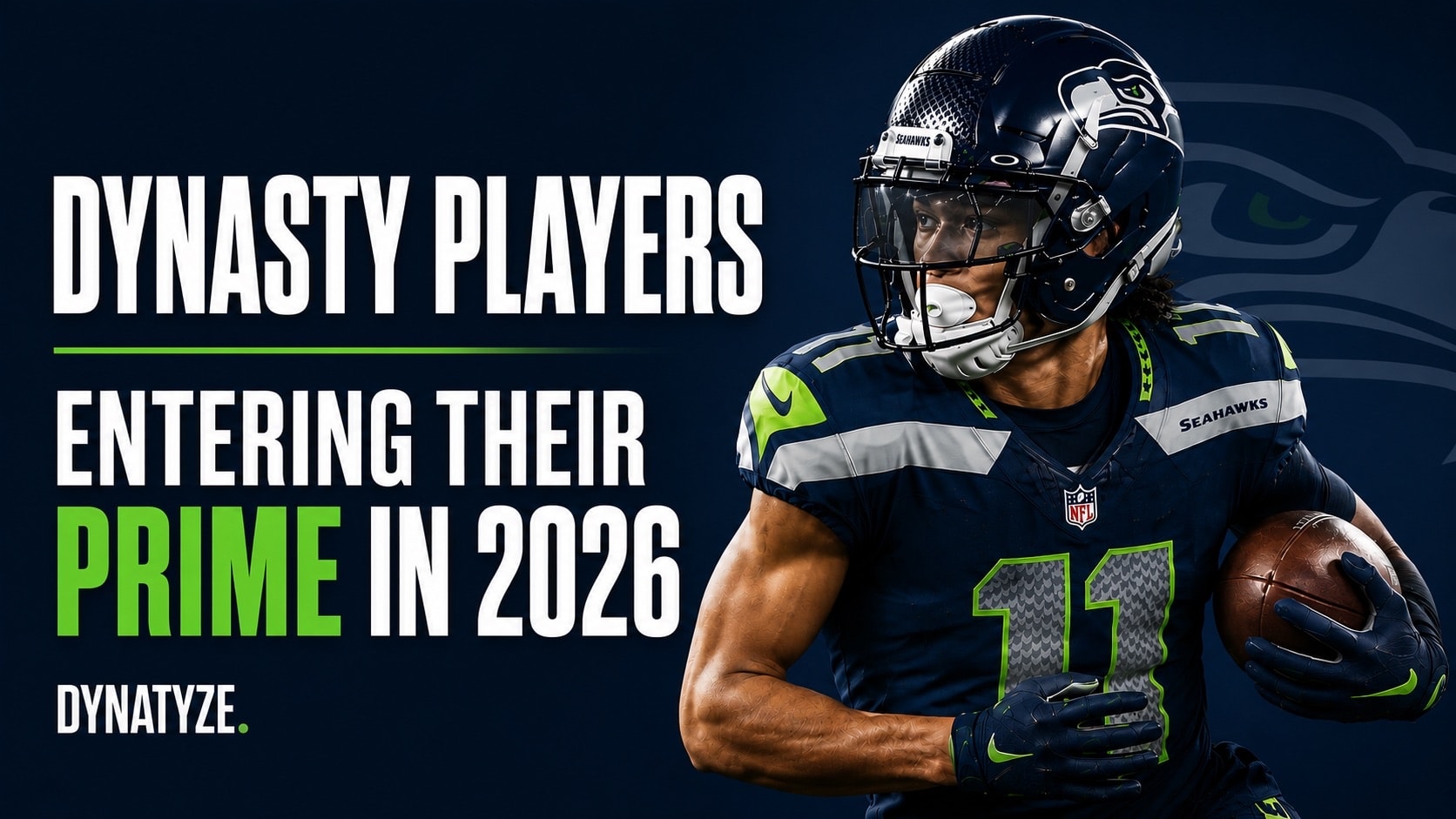
JAXON SMITH-NJIGBA, WR, SEATTLE SEAHAWKS
Age: 24 | Dynasty Rank: WR1
Last season put the debate to rest. Jaxon Smith-Njigba led the NFL in receiving yards in 2025 with 1,793 yards on 119 receptions and 10 touchdowns in 17 regular season games, earning AP Offensive Player of the Year honors and a Super Bowl ring. His PFF receiving grade of 93.1 ranked second among all 81 qualified wide receivers. His 3.85 yards per route run was the second-best single-season mark over the past decade, trailing only Puka Nacua's 3.80. He accounted for 44.1 percent of Seattle's receiving yards and a 32.6 percent target share, both league highs. He led the NFL in receptions (16) and yardage (614) on passes thrown 20-plus yards downfield. This was not a product of volume on a pass-heavy team. The Seahawks ranked 29th in pass attempts.
He then signed a four-year, $168.6 million extension with Seattle in March 2026, becoming the highest-paid wide receiver in league history at $42.15 million per year with $120 million guaranteed.
The dynasty case now is not about whether JSN is elite. That is settled. The case is about what comes next and whether the 2025 season represents a repeatable level of production or a peak. The answer is that 24-year-old wide receivers in their statistical breakout season almost never decline the following year. They consolidate. The target share is real because DK Metcalf is in Pittsburgh and Tyler Lockett is gone. Cooper Kupp joined Seattle in free agency, but Kupp is 33 years old and has played more than 14 games once in the last four seasons. The No. 1 role is not in danger. Sam Darnold is under center, and while that is a legitimate limitation on ceiling, Darnold proved during his run in 2025 that he can function in the right infrastructure. Seattle's infrastructure is built for Jaxon Smith-Njigba.
He is 24 years old. He has a Super Bowl, an OPOY award, and the richest wide receiver contract in NFL history. Dynasty managers who are still treating him as a "wait and see" hold rather than a cornerstone asset are making a mistake.
ROME ODUNZE, WR, CHICAGO BEARS
Age: 24 | Dynasty Rank: Rising WR1
Everything about Rome Odunze's first two seasons in Chicago has been colored by Caleb Williams, and that framing has done Odunze a disservice.
Odunze is 6-3, 215 pounds with a 4.45 40. He was the third overall pick at wide receiver in the 2024 NFL Draft and went fifth in dynasty rookie ADP that year. His college profile at Washington was exceptional: two 1,000-yard seasons, 225 career receptions, and a 72.6 percent catch rate. In Year 1 with Chicago, he finished with 56 receptions for 806 yards and 4 touchdowns. In 2025, his production improved to a 78-1,063-6 line across 16 games, and his efficiency metrics were quietly elite, finishing among the top-25 receivers in yards per route run.
Williams appears to be developing as a quarterback. The Bears added weapons around him in the offseason, including Luther Burden in the 2025 class and Emeka Egbuka in 2026's draft. A more crowded receiving room is not necessarily a ceiling problem for Odunze. The Bears rank in the bottom third of the league in pass attempts, which means every additional receiver added is not just targeting Wilson Wilson's volume but also expanding the overall passing game as the scheme opens up. Odunze at 24 with a legitimate offensive infrastructure developing around him is a dynasty target who is still being priced as a speculative hold rather than an established producer. That pricing is wrong. Hold.
THE BOTTOM LINE
The dynasty market consistently makes the same error with players between 22 and 26: it prices recent injury or situational failures as though they represent the player's ceiling rather than temporary obstacles. Gibbs losing Montgomery changes his entire 2026 projection. Nabers entering Year 3 with a functional quarterback and a clean knee is different from Nabers in 2025. Wilson with Geno Smith is different from Wilson with Justin Fields behind an offensive line that generated negative game scripts all year.
The players on this list are not speculative prospects. They have NFL production on their resumes. They have clear paths to more in 2026. The managers who buy these players now, before the market catches up to their situations, are the ones building dynasty rosters that will win multiple championships over the next five years. Every player on this list is either at, entering, or approaching the peak production window that dynasty value is built on. The only question is whether you own them before everyone else figures that out.