For the complete documentation index, see llms.txt. Markdown variants of the ranked boards (dynasty and fantasy rankings for NFL, NBA, MLB and CFB) are available by appending .md to those URLs or by sending Accept: text/markdown; other pages answer 404.
DYNATYZE
This page's interactive half has not started on this device. Nothing was read, and nothing was invented in its place. Reload the page.
Loading the football page
Dynasty Brain Is Ruining Your Redraft Fantasy Rosters
redraft
Dynasty Brain Is Ruining Your Redraft Fantasy Rosters
Stop wasting away your annual league dues because you can't take off your dynasty goggles when drafting your redraft squad.
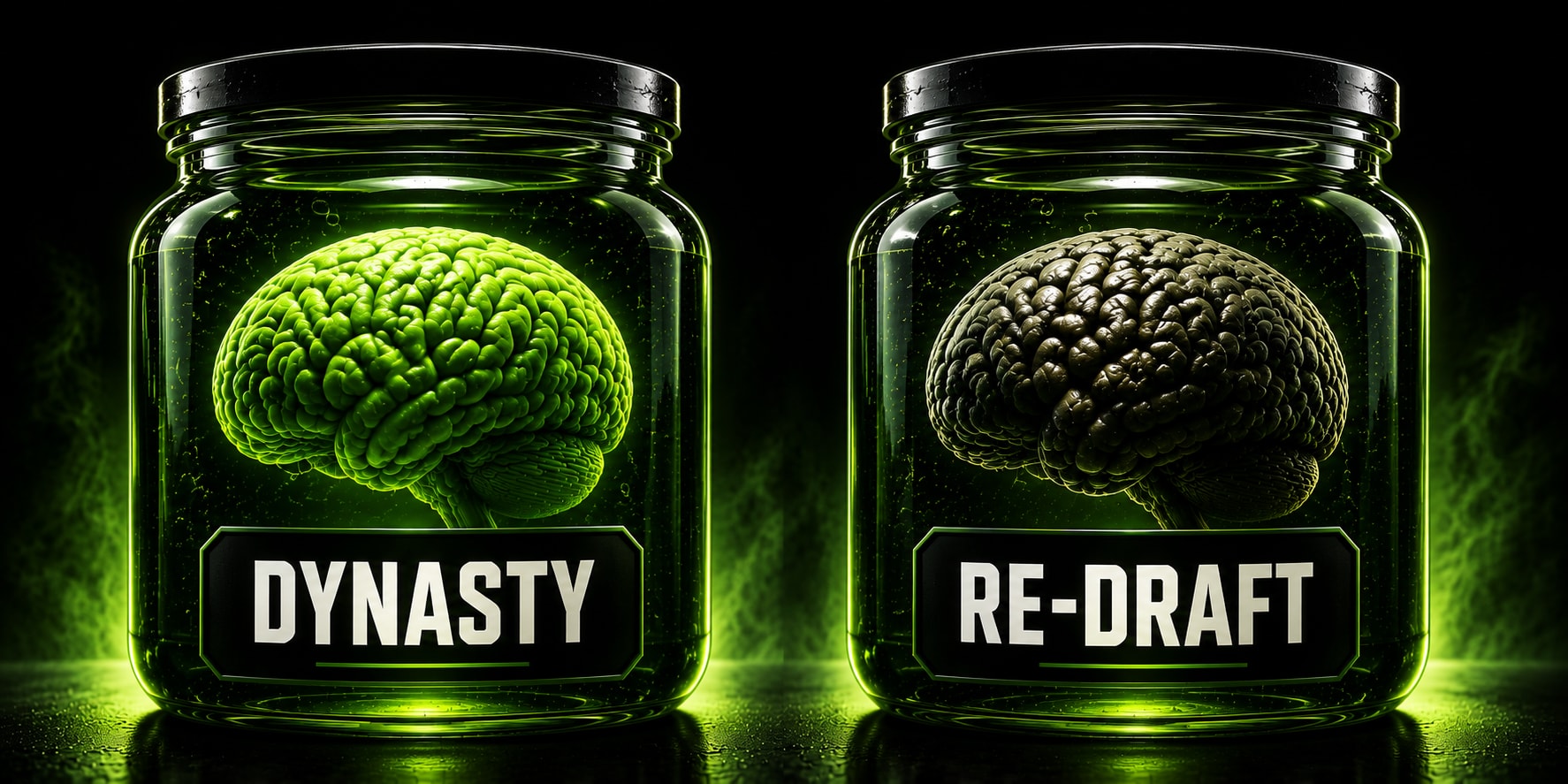
Dynasty fantasy football and redraft fantasy football are two entirely different games. I call it “Dynasty Brain” vs. “Redraft Brain”.
You can easily let the hype of unproven prospects cloud your judgment and control your decisions.
That is how managers who drafted Ashton Jeanty (LV) over Puka Nacua (LAR) or De’Von Achane (Mia) hurt their overall rosters. They couldn’t take off their dynasty goggles. They’ll make the same mistake this year by drafting a high-profile prospect like Jeremiyah Love (Ari) over a proven asset like James Cook (Buf).
Stop Drafting Like You’re In a Startup
Using the wrong “brain” can cause massive mistakes for managers who play in multiple fantasy formats. Dynasty is a value game; redraft is a production game. Redraft doesn’t care what your roster will look like in a year. You’ve got one shot to make it to the playoffs with this roster; that’s it. To avoid Dynasty Brain, we need to rewire our tactics. Some managers make the mistake of completely ignoring rookie talent profiles and drafting strictly off ADP. This can still leave you with a roster full of mediocrity on the bench because you’ve failed to consider the upside rookie models can project. This is important when filling out your bench or making future waiver claims, not your starting roster. Upside wins leagues, and good models can show you where there’s upside. Understanding how to apply this data is what can give you the edge over your average league mate who is just following “Expert Rankings” on XYZ Fantasy Site. In dynasty, we draft rookies with good profiles because we can wait for them to blossom into their peak roles. Obviously, we don’t have that same luxury of time for redraft.
Age Cliffs and Long-Term Contracts Don’t Matter In September
If you’re like me, when you play in both dynasty and redraft leagues, you can find it difficult to switch your process back and forth based on what format the roster you’re currently looking at is playing in. I’ve had to stop myself from naturally gravitating towards young talent and fading aging vets when playing in redraft leagues. In dynasty, age cliffs and contract insulation matter more. I typically prefer to get out on an aging asset a year early instead of a year late. This can make drafting or trading for older vets feel like the wrong play. Especially if the majority of the leagues you play in are dynasty, which is my preferred format.
Whenever I’m considering guys like Derrick Henry (Bal) or Chase Brown (Cin) , I have to force myself to remember that my concerns for their long-term viability aren’t a concern in redraft formats like it is in dynasty. It’s their weekly production that matters. Dynasty puts more value on youth and contract insulation compared to redraft. A high draft capital, rookie talent profile doesn’t always equate to the immediate NFL production that you need for your roster this year.
Many redraft fantasy managers, myself included, got burned by TreVeyon Henderson (NE) last year. He was an exciting running back prospect that was expected to eventually be the lead back for New England. Rhamondre Stevenson (NE) put that dream to rest when he shocked all of us with last year’s performance. The lesson I want you to learn here is that drafting a young running back who needs an injury to pay off a high price tag is generally a bad pick. We want immediate production when making our early draft selections.
Stop Wishcasting on Preseason Hype
I’ve found that many struggle most with Dynasty Brain when it comes to wide receiver valuations. Every preseason, I see a weaker wide receiver prospect getting hyped up because of a slow-mo video from training camp or some beat writer’s report. Last year, it was players like Kyle Williams (NE) and Dont’e Thornton (LV). This year it’s happening to Cyrus Allen (KC). In dynasty, these are the player archetypes that you stash to see if they hit. In redraft, that roster spot is tainted since you need guaranteed target share right now. I’ve seen people trade away significant draft capital for these hype train players in dynasty, and that hype leaks into redraft. Instead of taking players with substantially higher ceilings, I’ve seen people reach on these players in their yearlong drafts. The most predictive metric for this year’s production is last year’s production, with some added context like health and offseason changes.
Last year, wide receiver Luther Burden (Chi) broke out in a big way at the end of the season. His efficiency metrics were off the charts! I’m high on him, like many in the community, because he’s showcased the efficiency at the NFL level. If he gets the volume to pair with that efficiency, he stands to become a massive breakout candidate this year. Targets for wide receivers are not the same as touches for running backs. Targets are earned, and touches are given. A rule of thumb that I’ve found to be generally true is that if a wide receiver doesn’t earn a significant target share (20% or more) by Year 2, then they likely never will. I make bets based on these metrics while others wishcast on hopium.
You Don’t Need a Franchise Quarterback
The typical dynasty format includes a deep bench, a superflex position, but forgoes defense and kickers. The typical redraft format on platforms like Sleeper, ESPN, and Yahoo defaults to shallow rosters, one quarterback with defenses and kickers.
In dynasty (superflex), QBs are gold that hold value for a decade. In redraft, single-QB settings make the position much more plug-and-play. You can often find replacement QB options on the waiver wire if needed for bye weeks and injuries. This is less common for the other positions.
This allows for the savvy drafters to wait on the position until the right value hits. QBs like Jared Goff (Det) constantly fall in drafts, yet annually put up top-12 numbers. You don’t have the same level of urgency to lock down your QB position in this format as you do in most dynasty leagues. You don’t need a guy who’s the franchise QB for the next five years. You can safely draft the guy who’s got upside on a “prove-it year,” like Kyler Murray (Min) is now for the Vikings or Matthew Stafford (LAR), who could retire if the Rams get to another Super Bowl appearance. When drafting QBs, look for these three things: the offensive environment, their rushing floor, and their P ass Rate Over Expected (PROE) . If you’re drafting a statue like Matthew Stafford (LA), you want him passing a ton to keep up with QBs who run.
Spending Your Cash
FAAB is becoming more common in redraft leagues instead of standard waiver claims. It’s great because it’s the fairest way to acquire free agents during the season. In dynasty, the waiver wires are typically much thinner than in redraft leagues. Generally, there’s not a player of the same caliber available on the wire in dynasty as there is in redraft. Specifically, backup running backs, as almost all are already rostered. In redraft, this isn’t the case. If a significant injury occurs to a running back, like it almost happened to Ashton Jeanty (LV) recently, then you need to be prepared to be very aggressive with your FAAB. You spend FAAB on dart throws in dynasty. In redraft, you strategically spend it when the starting running back suffers a season-ending injury. Dynasty and redraft are two entirely different fantasy football games. Don’t let yourself lag behind your opponents because you’re using the wrong brain! Time isn’t a luxury we have in redraft. We need to win early and often. Locking in that playoff spot is paramount. Looking for MORE fantasy football insight? Check out our ARTICLES page
Think Like a GM
Start managing your team on Dynatyze, where our data & tools lead to championships. Sign up for an account today and dominate your league