For the complete documentation index, see llms.txt. Markdown variants of the ranked boards (dynasty and fantasy rankings for NFL, NBA, MLB and CFB) are available by appending .md to those URLs or by sending Accept: text/markdown; other pages answer 404.
DYNATYZE
This page's interactive half has not started on this device. Nothing was read, and nothing was invented in its place. Reload the page.
DYNATYZE
Loading Baseball
This page's interactive half has not started on this device. Nothing was read, and nothing was invented in its place. Reload the page.
Inside the Dodgers’ $1.45 Billion SportsNet LA Debt Web
MLB Analysis
Inside the Dodgers’ $1.45 Billion SportsNet LA Debt Web
How do the Dodgers keep spending? A look inside the $1.45 billion SportsNet LA debt web connecting the team’s TV network and ownership circle.
For years, baseball fans have asked essentially the same question:
How can the Los Angeles Dodgers keep doing this?
The massive contracts. The unprecedented deferrals. The seemingly endless ability to add another superstar even after assembling one of baseball's most expensive rosters.
Part of the answer has always been obvious: the Dodgers are enormously valuable, play in the country's second-largest media market and own one of the richest local television arrangements in professional sports.
But newly highlighted insurance filings add another fascinating layer to the financial machinery surrounding the organization.
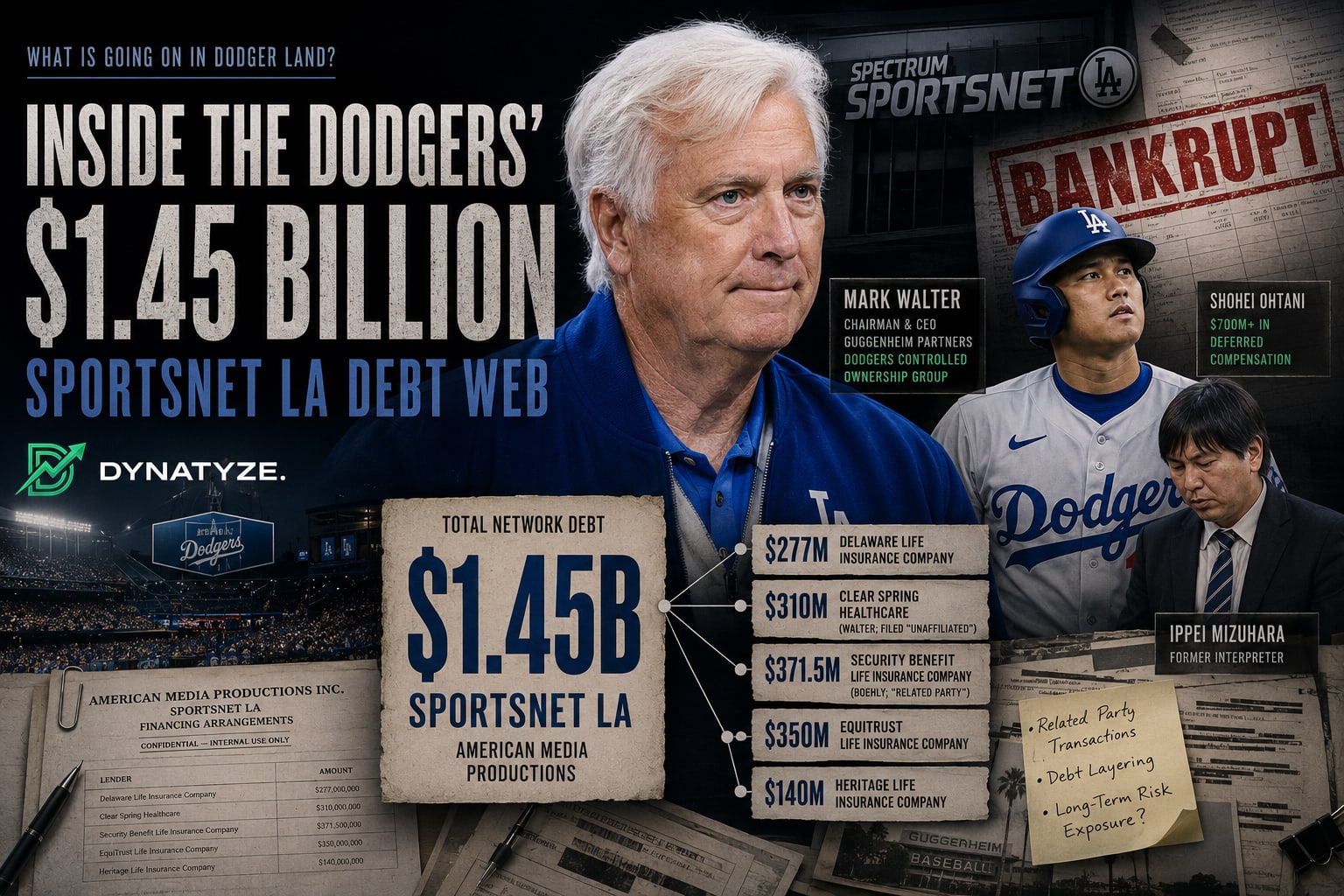
Research published by Nick Nemeth of Mispriced Assets traces approximately $1.45 billion of debt issued by American Media Productions LLC — the entity that owns SportsNet LA — to five life insurance companies with connections to members of the Dodgers' ownership orbit. ( Mispriced Assets )
And once you start following the money, the structure gets complicated very quickly.
First, You Need to Understand SportsNet LA
In 2013, shortly after Guggenheim Baseball Management purchased the Dodgers, the organization announced the creation of SportsNet LA.
American Media Productions LLC, or AMP, was created to own the network.
The Dodgers then entered into the enormous television arrangement that has helped define their financial advantage ever since: a 25-year deal valued at approximately $8.35 billion.
Charter Communications now serves as SportsNet LA's exclusive affiliate and advertising sales representative and provides production and technical services. Those agreements run through 2038. ( SEC )
This structure isn't some newly discovered secret.
In fact, concerns about its implications existed from the beginning. ESPN reported in January 2013 that a baseball source viewed the arrangement as precisely the type of structure MLB feared could reduce the amount of television proceeds subject to revenue sharing. ( ESPN.com )
More than a decade later, however, we're getting a much more detailed look at another part of the machine:
Who actually owns AMP's debt?
Approximately $1.45 Billion — Across Five Insurers
According to the insurance filings compiled by Nemeth, roughly $1.45 billion of American Media Productions notes are held across five life insurers:
• Delaware Life Insurance Co. — approximately $277 million
• Clear Spring Life and Annuity Co. — approximately $310 million
• Security Benefit Life — approximately $371.5 million at fair value
• EquiTrust Life — approximately $350 million
• Heritage Life Insurance Co. — approximately $140 million
Combined, that's approximately $1.45 billion.
What makes the figure interesting isn't merely the amount of debt.
It's who sits around it.
The Walter Connection
Delaware Life and Clear Spring together hold approximately $587 million of AMP debt.
Both have ties to Mark Walter's broader business network through Group 1001.
Nemeth's research found something particularly noteworthy in the statutory filings: the AMP securities appear within investments classified as corporate bonds from unaffiliated issuers.
His earlier investigation found the same two insurers holding approximately $587 million of AMP debt, with the positions representing unusually significant investments on their respective balance sheets. ( Mispriced Assets )
And Delaware Life's historical classification makes the story even more interesting.
According to the filings reproduced in Nemeth's research, Delaware Life reported the AMP positions under bonds involving "Parent, Subsidiaries and Affiliates" in its 2024 statement, while its 2025 filing placed them among unaffiliated corporate bonds.
That does not automatically mean anything improper occurred.
But it's an accounting and regulatory distinction worth understanding.
Then There's Todd Boehly
Security Benefit provides perhaps the clearest example of how intertwined the broader ecosystem can become.
Its filings identify American Media Productions as a related-party investment.
The uploaded 2025 filing shows approximately $407.6 million of AMP investment on the relevant related-party schedule, while the research summary values the position at roughly $371.5 million on a fair-value basis.
This connection isn't new.
Forbes reported in 2024 that Security Benefit held hundreds of millions of dollars in American Media Productions and described insurance capital as an important component of Todd Boehly's broader investment empire. ( Forbes )
That means an insurer tied to a Dodgers co-owner has held a substantial investment in the entity operating the Dodgers' television network.
And Security Benefit explicitly identifies it as related-party exposure.
EquiTrust and Heritage Add Another $490 Million
The web extends further.
EquiTrust's filings show approximately $350 million of American Media Productions bonds.
Heritage Life holds another approximately $140 million.
That brings the combined figure identified across the five insurers to roughly:
$1.45 BILLION.
And that's where this stops looking like a random collection of institutional investors.
The same ownership ecosystem surrounding one of baseball's richest franchises repeatedly appears around the debt financing of the entity responsible for that franchise's enormously valuable television network.
Why This Matters for the Dodgers
This does not mean the Dodgers have secretly discovered "free money."
It also doesn't prove that MLB rules have been violated.
But it helps illustrate why simply comparing the Dodgers' payroll to another team's payroll misses the larger picture.
The Dodgers aren't operating solely as a baseball team collecting ticket sales and television checks.
They exist inside a much broader financial ecosystem involving:
sports ownership,
media rights,
asset management,
insurance capital,
private credit,
and long-duration financing.
SportsNet LA is particularly important because the Dodgers' television economics are already extraordinary.
While regional sports networks around baseball have experienced severe financial stress, SportsNet LA remains attached to a distribution arrangement running through 2038 with one of America's largest cable companies. Charter itself continues to describe AMP as the owner of SportsNet LA and its exclusive partner under agreements extending through 2038. ( SEC )
That creates something few MLB organizations possess:
long-term visibility into enormous local-media economics.
And Then Come the Deferrals
Now add the other side of the Dodgers' financial strategy.
Payroll doesn't necessarily mean cash paid today.
Los Angeles has aggressively used deferred compensation to push enormous portions of player contracts into future years.
Shohei Ohtani is the obvious example, but he's hardly the only one.
Recent reporting has put the Dodgers' total deferred commitments above $1 billion extending decades into the future. ( Journal de Québec )
That's crucial because a $700 million contract doesn't necessarily require $700 million of cash during the years in which the player is actually producing for the Dodgers.
The organization can preserve present-day liquidity while accepting substantial future obligations.
Combine that with one of baseball's most lucrative media arrangements and an ownership group deeply experienced in insurance, credit and asset management, and the Dodgers' financial advantage starts looking considerably more sophisticated than:
"They're a big-market team."
The Question Isn't Whether the Dodgers Are Rich
We already knew that.
The more interesting question is how their entire financial ecosystem works together.
American Media Productions owns SportsNet LA.
SportsNet LA sits at the center of the Dodgers' enormous television arrangement.
Approximately $1.45 billion of AMP debt has now been identified across five insurance companies connected in various ways to people within the Dodgers' ownership orbit.
Some of that exposure has been reported as related-party investment.
Other positions have appeared as unaffiliated investments.
Meanwhile, the Dodgers continue using enormous deferred contracts to shift significant payroll obligations years — and sometimes decades — into the future.
None of those facts alone proves wrongdoing.
Together, however, they reveal something much more interesting than another story about the Dodgers spending too much money.
They show just how financially sophisticated the machine behind baseball's biggest spender has become.
And considering that the original SportsNet LA structure raised revenue-sharing questions from the moment it was created, the newly surfaced insurance relationships deserve considerably more attention.
The question surrounding the Dodgers may no longer simply be:
"How can they afford this?"
It might be:
"How exactly is the machine that allows them to afford it structured?"