For the complete documentation index, see llms.txt. Markdown variants of the ranked boards (dynasty and fantasy rankings for NFL, NBA, MLB and CFB) are available by appending .md to those URLs or by sending Accept: text/markdown; other pages answer 404.
DYNATYZE
This page's interactive half has not started on this device. Nothing was read, and nothing was invented in its place. Reload the page.
DYNATYZE
Loading Baseball
This page's interactive half has not started on this device. Nothing was read, and nothing was invented in its place. Reload the page.
5 Fantasy Baseball BUY Calls: Did I Get Them Right?
MLB Analysis
5 Fantasy Baseball BUY Calls: Did I Get Them Right?
We revisit five fantasy baseball hitters we recommended buying in August to see which calls delivered and which one completely missed.
A little over a month ago, I highlighted five hitters to BUY heading into the fantasy baseball playoffs.
The idea wasn't to simply grab five players who had been hot. Using FanGraphs data from July 8 through August 8, we looked at wOBA, xwOBA, exit velocity, barrel rate, and BABIP to find hitters whose underlying numbers gave us a reason to believe in what was coming next.
The five names were Wilyer Abreu, Pete Alonso, Royce Lewis, Fernando Tatis Jr., and Riley Greene.
Now we have more than a month of new data.
Using FanGraphs numbers from August 8 through September 12, it's time to go back and grade the calls.
And the results were pretty damn good.
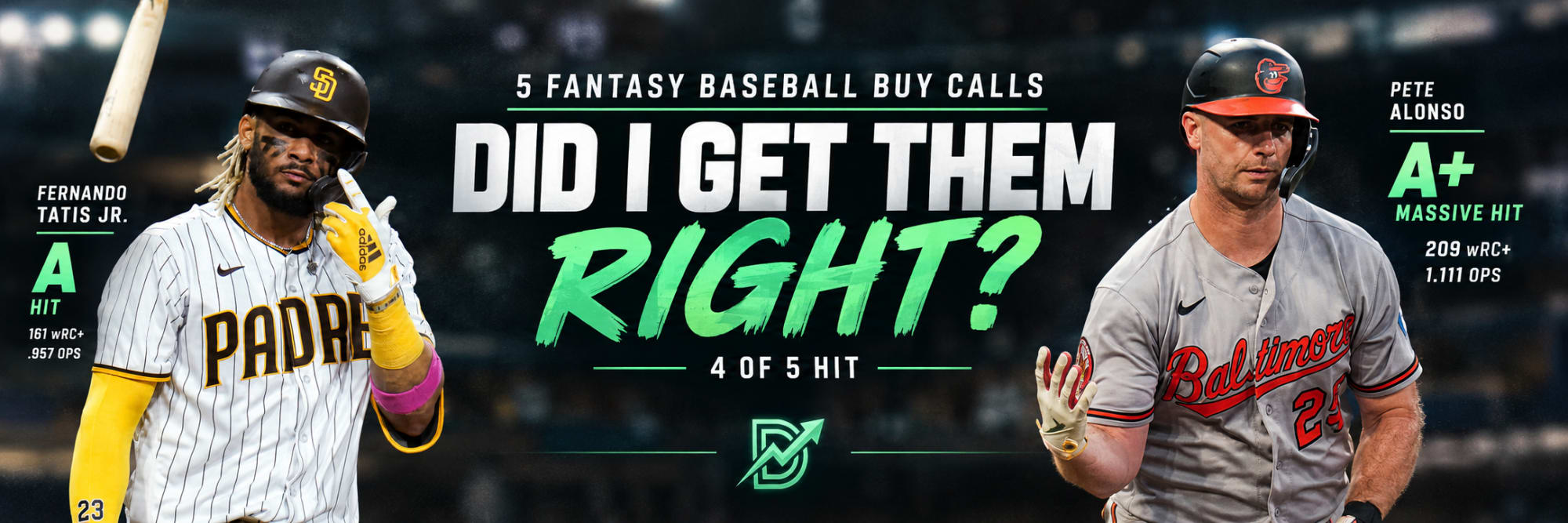
Four of the five hitters produced a 132 wRC+ or better over the follow-up window. Three were above 160.
When Alonso originally made the list, his .330 wOBA was sitting all the way below a .389 xwOBA. He was also averaging 93.7 mph in exit velocity with a 15.9% barrel rate. The production wasn't bad. The underlying numbers were simply telling us he was capable of considerably more.
Then he exploded.
Since August 8, Alonso has hit .351/.444/.667 with 11 home runs and 26 RBI across 31 games. His 1.111 OPS leads this entire group, while his 209 wRC+ means his offensive production was more than twice league average after adjusting for context.
And this wasn't some BABIP-fueled hot streak with nothing underneath it.
Alonso posted a .467 wOBA against a .453 xwOBA. His average exit velocity actually climbed to 94.8 mph, with a 17.2% barrel rate and ridiculous 63.2% hard-hit rate.
He barreled 15 balls in 87 batted-ball events.
Nearly two-thirds of his contact qualified as hard-hit.
The original thesis was that a hitter making this kind of contact should eventually produce more damage than his surface numbers showed.
At the time, Tatis had a .375 wOBA, .381 xwOBA, and the highest average exit velocity of anyone on the list at 94.2 mph.
Somehow, he hit the ball even harder afterward.
Tatis produced a 95.3 mph average exit velocity from August 8 through September 12, the best of these five hitters again. He paired it with a 17.3% barrel rate and 57.1% hard-hit rate.
The fantasy production followed.
Ten homers. Twenty-two runs. Twenty-one RBI. Six steals. A .957 OPS.
That's basically the complete fantasy package we were hoping to buy.
There's another interesting number here too: his .443 xwOBA actually exceeded his already excellent .403 wOBA.
So even after producing at a 161 wRC+ level, the quality of Tatis' contact suggests this stretch wasn't some massive overperformance.
His bat-tracking numbers reinforce it. Tatis led this group with a 76.8 mph bat speed and posted a 22.2% blast rate.
Greene was probably the strangest profile in the original article.
His average exit velocity over the previous window was only 86.5 mph, yet he carried a massive 17.7% barrel rate, .375 xwOBA, and a 54-point gap between his expected and actual wOBA.
The question was whether the high-end contact was meaningful enough to outweigh the mediocre average exit velocity.
Over the next month, Greene answered it.
He posted a .406 wOBA, .412 xwOBA, and 164 wRC+ while slugging .600.
Most importantly, the barrels didn't disappear.
Greene's barrel rate actually increased to 20.0%, the highest of these five hitters during the follow-up window. Five of his 25 batted-ball events were barrels.
His average exit velocity remained relatively modest at 86.1 mph, but that's exactly why Greene remains such an interesting hitter to evaluate. His best contact has been extremely damaging even though his average contact quality doesn't jump off the page.
He also posted a .956 OPS despite striking out 33.3% of the time.
That strikeout rate is something to monitor, and the sample is smaller at only 45 plate appearances. But strictly grading what happened after the BUY recommendation, the production absolutely arrived.
Abreu was arguably the most obvious positive-regression candidate in the original piece.
He had managed a .379 wOBA despite a ridiculous .212 BABIP, while producing a .415 xwOBA and 19.7% barrel rate.
The follow-up wasn't the monster explosion we saw from Alonso, but Abreu remained a very productive hitter.
He posted a .836 OPS and 132 wRC+ across 30 games while scoring 15 runs and hitting four home runs.
Interestingly, the shape of the profile changed.
His BABIP increased from .212 in our original evaluation window to .286, but his contact quality cooled considerably. Abreu's average exit velocity fell to 88.7 mph, and his barrel rate dropped to 10.1%.
That matters when grading the original thesis.
We were correct that the .212 BABIP left room for better batted-ball results, but the elite barrel production that made the original profile so exciting didn't completely carry forward.
Still, a 132 wRC+ is a 132 wRC+.
Abreu remained a well-above-average offensive player during the exact stretch fantasy managers were buying him for.
The call worked, even if it didn't work exactly the way we envisioned.
Lewis was awful offensively during the follow-up window.
When we originally highlighted him, the argument was different from the positive-regression cases. Lewis had a .384 wOBA and .388 xwOBA, meaning his strong production was being validated almost perfectly by the expected numbers.
We weren't waiting for his results to catch up.
We were betting that what he was already doing was legitimate.
It didn't continue.
Lewis hit just .216/.254/.297 over the next 29 games. His wRC+ cratered to 52, easily the worst of this group.
The underlying numbers were bad too.
His average exit velocity fell to 89.0 mph. His barrel rate dropped to 7.4%. His ISO was only .081, and he struck out 26.3% of the time while walking just 5.1%.
There is a little bit of evidence that the results were harsher than the contact deserved. His .280 xwOBA was better than his .245 wOBA, while his .357 xSLG topped his actual .297 SLG.
But we're talking about degrees of bad here.
Even the expected numbers weren't close to supporting the hitter we saw during the original evaluation window.
This one missed.
Grade: F
Final Thoughts
This is exactly why I wanted to revisit the original article.
It's easy to publish a list of BUY candidates and never look at it again. It's much more useful to go back once we have another month of data and see whether the process actually worked.
In this case, four of the five calls delivered.
Pete Alonso was the monster. He went from a .330 wOBA with a .389 xwOBA in our original evaluation window to a .467 wOBA, 1.111 OPS, and 209 wRC+ afterward.
Fernando Tatis Jr. continued absolutely crushing the baseball and produced a .957 OPS with 10 homers and six steals.
Riley Greene maintained the unusual high-barrel profile that made him interesting in the first place and finished the follow-up window with a 164 wRC+.
Wilyer Abreu's contact quality cooled, but he still produced a strong .836 OPS and 132 wRC+.
And Royce Lewis?
I missed.
That's a 4-for-5 result, but the bigger takeaway is why each call succeeded or failed.
Expected statistics aren't predictions carved in stone. A large wOBA/xwOBA gap doesn't guarantee a hitter is about to explode, and one month of excellent contact doesn't guarantee he'll maintain it.
What these metrics can do is give us a better picture of what's happening underneath the traditional stat line.
Last time, they gave us five hitters worth buying.
A month later, four of them delivered. Looking for MORE fantasy baseball insight? Check out our ARTICLES page
Think Like a GM
Start managing your team on Dynatyze, where our data & tools lead to championships. Sign up for an account today and dominate your league.