For the complete documentation index, see llms.txt. Markdown variants of the ranked boards (dynasty and fantasy rankings for NFL, NBA, MLB and CFB) are available by appending .md to those URLs or by sending Accept: text/markdown; other pages answer 404.
DYNATYZE
This page's interactive half has not started on this device. Nothing was read, and nothing was invented in its place. Reload the page.
DYNATYZE
Loading Baseball
This page's interactive half has not started on this device. Nothing was read, and nothing was invented in its place. Reload the page.
Checking the Receipts: Did Our 5 Fantasy Baseball BUYs Hit?
MLB Analysis
Checking the Receipts: Did Our 5 Fantasy Baseball BUYs Hit?
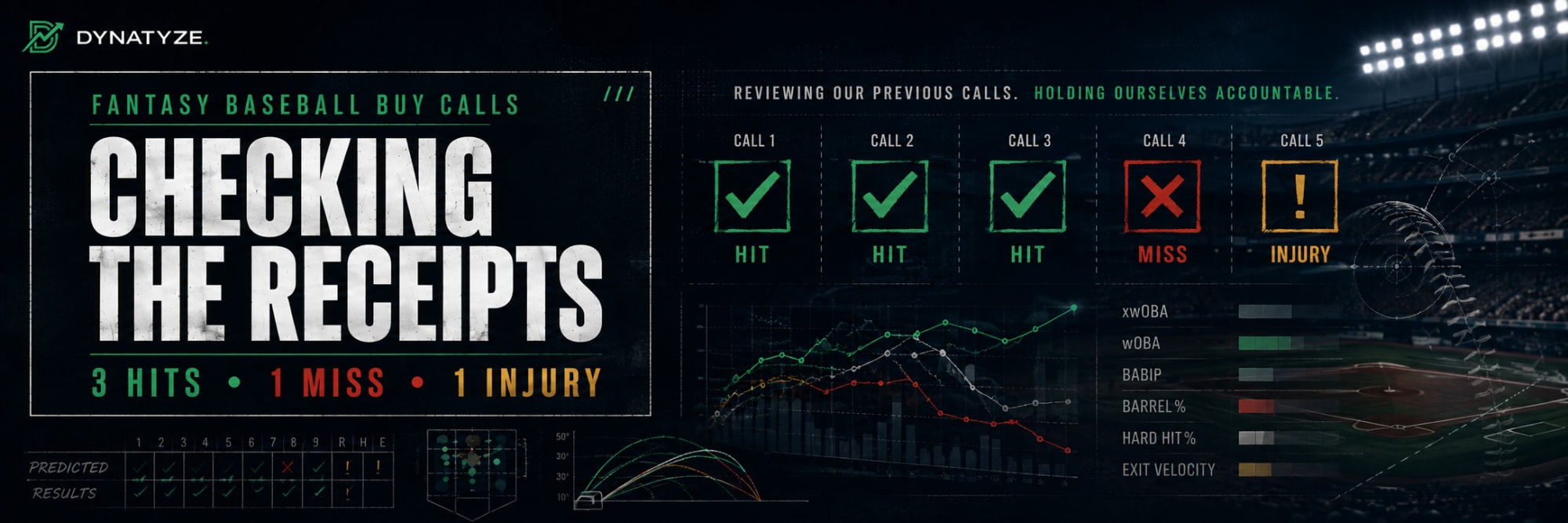
Three BUY calls hit, one missed, and one ended in injury. We’re checking the receipts on our fantasy baseball targets.
On August 8, I identified five hitters fantasy managers should be targeting before the fantasy playoffs.
The argument wasn't based on name value or recent box scores. It was built around what was happening underneath the surface.
Wilyer Abreu was carrying an absurdly low BABIP while barreling nearly one out of every five batted balls. Pete Alonso's expected production was dramatically better than his results. Royce Lewis was crushing the baseball. Fernando Tatis Jr. continued to show elite contact quality. Riley Greene paired a huge barrel rate with an xwOBA well above his actual production.
A couple of weeks later, we can finally check the receipts.
And the results were pretty damn good.
Three calls hit.
One missed.
And one never really got the opportunity to play out because of injury.
Alonso has also launched 9 home runs over the stretch.
The original argument was that his .330 wOBA wasn't accurately reflecting the quality of contact underneath it. Alonso had a .389 xwOBA, 93.7 mph average exit velocity and a 15.9% barrel rate.
We wanted to trust the contact.
Good decision.
Since then, his contact quality has somehow become even more absurd.
Alonso has averaged 94.8 mph off the bat while producing a 65.4% hard-hit rate and 19.2% barrel rate .
His xwOBA over the new sample is an elite .525 .
Now, let's be clear: nobody should expect a .484 batting average or 307 wRC+ to continue.
His current .500 BABIP is obviously doing plenty of work, and his actual .609 wOBA is now substantially higher than his .525 xwOBA.
That's the funny part.
When we bought him, the results were lagging behind the skills.
Now the results have blasted straight past them.
But that's exactly why buying the underlying profile mattered. The hitter we were targeting because he was consistently crushing the baseball finally started receiving the results that quality of contact was capable of generating.
Original call: BUY
Result: MASSIVE HIT
Fernando Tatis Jr.: HIT
I feel like I've written this sentence about 15 times this season:
Keep buying Fernando Tatis Jr.
And apparently I'm going to keep writing it.
When we published the original article, Tatis had produced:
The barrel rate has cooled significantly from the crazy 19.7% figure that drove the original recommendation, so we didn't get the enormous offensive explosion that Alonso or Tatis delivered.
But the entire purpose of buying Abreu was acquiring a hitter whose underlying profile suggested legitimate above-average offensive production.
Since the call, he's produced a 121 wRC+ .
That's a win.
Not every BUY recommendation needs to turn into Barry Bonds for three weeks.
Original call: BUY
Result: HIT
Royce Lewis: MISS
Here is where we take the L.
Royce Lewis looked like one of the safest profiles in the original article.
Unlike Alonso or Abreu, we weren't really waiting for regression.
His:
.384 wOBA
was nearly identical to his:
.388 xwOBA
And he had been producing a 92.6 mph average exit velocity with a 13.9% barrel rate .
The production looked legitimate.
Since then, it has completely disappeared.
Lewis has hit:
.238 AVG | .273 OBP | .302 SLG | .574 OPS
with a:
.257 wOBA 60 wRC+
The power has vanished.
Zero home runs.
His barrel rate has collapsed to 4.3% .
His hard-hit rate has fallen all the way to 28.3% .
His average exit velocity sits at just 88.1 mph .
Even the expected metrics aren't providing much of an excuse.
Lewis owns a .280 xwOBA during this stretch.
That's slightly better than his actual .257 mark, but nowhere close to enough to rescue the original call.
This is an important reminder about expected statistics.
They describe what a hitter has done underneath the results.
They aren't guarantees that those skills will remain unchanged.
When we made the recommendation, Lewis' contact quality supported his production.
Since then, the contact quality itself has deteriorated.
That's not bad luck.
That's a bad stretch.
Original call: BUY
Result: MISS
Riley Greene: INCOMPLETE
And then we have the one call we can't really grade.
Greene appeared in only three games and 10 plate appearances during this new sample before injury removed him from the equation.
Technically, the numbers are ugly:
.125 AVG | .300 OBP | .125 SLG
with a:
42 wRC+
But grading an offensive recommendation on 10 plate appearances would be ridiculous.
There simply isn't enough baseball here.
The original case was interesting because Greene had been carrying:
.321 wOBA
against a:
.375 xwOBA
while generating a massive:
17.7% barrel rate
The question was whether those underlying power indicators would eventually translate into better production.
Because of the injury, we never got a meaningful answer.
So I'm not calling it a hit.
I'm not calling it a miss.
Original call: BUY
Result: INCOMPLETE DUE TO INJURY
The Final Scorecard
Two-plus weeks after the original five BUY recommendations:
Pete Alonso: HIT
From a .330 wOBA to a ridiculous .609 wOBA and 307 wRC+ .
Fernando Tatis Jr.: HIT
Now carrying a .475 wOBA, .524 xwOBA and 22.2% barrel rate .
Wilyer Abreu: HIT
A solid 121 wRC+ , with his .348 wOBA almost perfectly supported by a .351 xwOBA.
Royce Lewis: MISS
The contact quality disappeared, leading to a 60 wRC+ and .302 slugging percentage .
Riley Greene: INCOMPLETE
Only 10 plate appearances before injury made the sample essentially useless.
That's:
3 hits.
1 miss.
1 injury.
More importantly, it's a good reminder of what these articles are actually trying to accomplish.
The goal isn't pretending advanced metrics predict the future perfectly.
They don't.
It's using the information available to identify situations where fantasy market perception and underlying performance don't match.
Sometimes you get Pete Alonso immediately turning into the hottest hitter on the planet.
Sometimes Tatis' already elite underlying profile gets even better.
Sometimes you get the solid production you expected from Abreu.
And sometimes Royce Lewis reminds you that the skills themselves can change after you make the call.
That's fantasy baseball.
But if I'm going to be loud when the data points toward a buy, I'm also going to come back afterward and show you exactly how the calls actually turned out.
This time?
I'll happily take 3 for 4 on the players who actually stayed on the field.