For the complete documentation index, see llms.txt. Markdown variants of the ranked boards (dynasty and fantasy rankings for NFL, NBA, MLB and CFB) are available by appending .md to those URLs or by sending Accept: text/markdown; other pages answer 404.
DYNATYZE
This page's interactive half has not started on this device. Nothing was read, and nothing was invented in its place. Reload the page.
DYNATYZE
Loading Baseball
This page's interactive half has not started on this device. Nothing was read, and nothing was invented in its place. Reload the page.
I Told You to Buy Manny Machado. The Regression Arrived
MLB Analysis
I Told You to Buy Manny Machado. The Regression Arrived
Manny Machado’s brutal BABIP made him a clear buy-low. Now the correction has arrived, and the underlying numbers still point toward more production.
A little over a month ago, Manny Machado was one of the easiest buy-low cases in fantasy baseball.
The surface numbers looked ugly. The underlying numbers didn't.
Machado had spent the early portion of the season fighting through one of the worst stretches of his career, and even after the power began returning in June, his batting average remained stuck near the Mendoza Line.
The reason was sitting right in front of us:
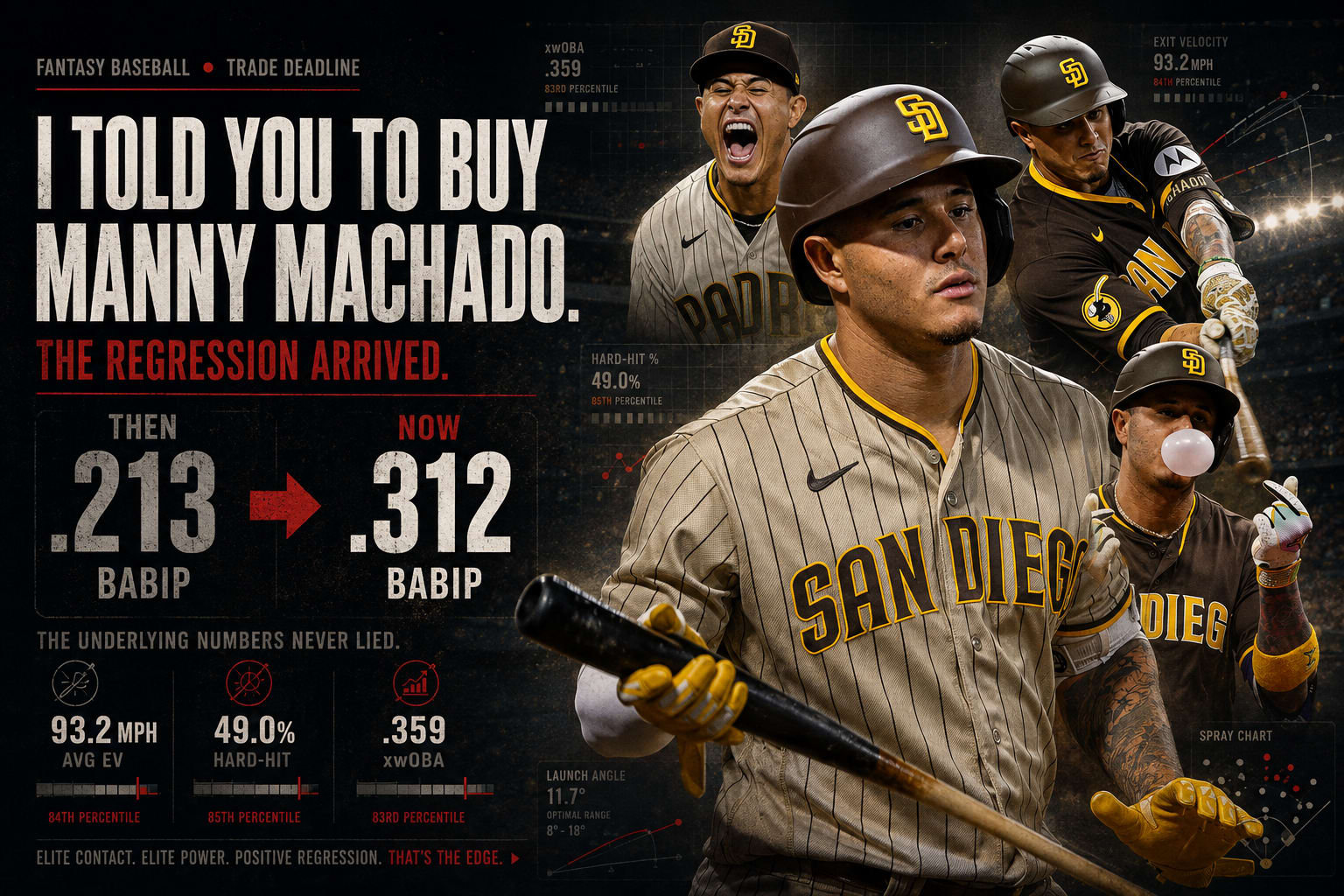
A .213 BABIP.
Machado was barreling the baseball more frequently, maintaining strong plate discipline and producing significantly more power, yet an absurd percentage of those batted balls continued turning into outs.
The bet was simple.
If the quality of contact remained intact and Machado's BABIP moved anywhere close to normal, the production would eventually follow.
Well...
The correction came.
Remember Where We Started
During our original buy-low breakdown, Machado's season had essentially been split into two completely different stretches.
From March through May, the results were brutal:
• .174 AVG
• .353 SLG
• 73 wRC+
• .179 ISO
• 11.6% BB%
• 22.7% K%
Then the calendar flipped to June.
Machado's batting average still didn't look particularly impressive, but everything underneath it began changing.
From June 1 through July 6:
• .216 AVG
• .308 OBP
• .509 SLG
• 120 wRC+
• .293 ISO
• 14.8% Barrel Rate
• 42.0% Hard-Hit Rate
• 90.0 MPH Average Exit Velocity
• 109.0 MPH Max Exit Velocity
The power had returned.
The approach remained intact.
Yet Machado was still carrying that ridiculous .213 BABIP .
That was the entire thesis.
The skills had already improved. The box score simply hadn't caught up yet.
The BABIP Correction Finally Arrived
Now look at Machado from July 6 through August 14 .
His BABIP has climbed all the way to:
.312
That's nearly a 100-point increase from the .213 mark we were staring at during the previous article.
And suddenly, the batting average doesn't look broken anymore.
Over this latest stretch, Machado has produced:
• .272 AVG
• .331 OBP
• .424 SLG
• .330 wOBA
• 111 wRC+
• .312 BABIP
This is exactly why BABIP was such an important part of the original buy case.
Machado didn't suddenly learn how to hit again in August.
The baseball simply started finding grass.
A .312 BABIP isn't some outrageous heater, either. It's a perfectly believable number for a hitter consistently producing quality contact.
Regression doesn't always mean a player suddenly becomes elite overnight.
Sometimes it simply means an unsustainably bad outcome finally begins normalizing.
That's exactly what we're seeing here.
And the Contact Quality Still Supports More
The most encouraging part isn't merely that Machado's BABIP corrected.
It's that the underlying contact profile remains strong enough to support the improvement.
From July 6 through August 14, Machado has produced:
• 93.2 MPH Average Exit Velocity
• 112.0 MPH Max Exit Velocity
• 49.0% Hard-Hit Rate
• 9.2% Barrel Rate
• 15.5° Average Launch Angle
That 93.2 mph average exit velocity stands out immediately.
Remember: during the June-July breakout stretch we were encouraged by a 90.0 mph average exit velocity.
He's now hitting the baseball even harder.
Nearly half of his batted balls have been classified as hard hit , and a 112 mph maximum exit velocity confirms that the raw power certainly hasn't disappeared.
The barrel rate has come down from that massive 14.8% June surge, but that's not especially concerning.
A 14.8% barrel rate was always an aggressive pace.
The important part is that Machado has continued producing impact contact even as that number normalized.
This isn't a hitter surviving on singles generated by a rising BABIP.
He's still hitting the baseball extremely hard.
The Expected Stats Say He Could Still Be Better
Here's where things become even more interesting.
Machado's actual production has improved considerably.
His expected production remains better.
Since July 6:
AVG: .272 xBA: .286
SLG: .424 xSLG: .473
wOBA: .330 xwOBA: .359
There is still a meaningful gap between what Machado has produced and what the quality of his contact suggests he could have produced.
His expected batting average sits 14 points higher than his actual average.
His expected slugging percentage sits nearly 50 points higher .
And his .359 xwOBA comfortably outpaces his .330 actual wOBA.
That's important because the original Machado argument was largely about positive regression.
Now we've gotten some of it...
And the expected statistics are essentially telling us:
There may still be more.
The Approach Hasn't Fallen Apart Either
Another concern with veteran hitters enduring early-season struggles is whether they're compensating.
Sometimes a player starts chasing more.
Sometimes strikeouts spike.
Sometimes they become overly aggressive trying to manufacture power.
That still hasn't happened with Machado.
From July 6 through August 14, he's struck out just 20.9% of the time.
That's right around where he was during both of our previous evaluation periods.
Remember:
March-May K%: 22.7%
June-July K%: 21.8%
July 6-August 14 K%: 20.9%
The strikeout rate has actually continued trending slightly downward.
His walk rate has fallen to 8.6% , so the plate-discipline profile isn't quite as pristine as it was during the June breakout. But nothing here suggests Machado has needed to fundamentally change his approach to generate these results.
He's putting plenty of balls in play.
He's hitting them hard.
And now they're finally becoming hits.
This Is Why We Buy Skills, Not Box Scores
Machado's season is almost a perfect example of why fantasy managers can't evaluate players solely by batting average.
When we originally highlighted him as a buy, someone looking only at the box score could reasonably ask:
Why would I trade for a hitter batting .216?
But that ignored everything happening underneath the surface.
The isolated power had jumped.
The barrel rate had exploded.
The hard contact remained strong.
The strikeout rate was actually improving.
And the BABIP was sitting at an absurd .213.
One month later, his BABIP is .312 and his batting average is .272.
Nothing magical happened.
The results simply began catching up to the skills.
Is Machado Still a Buy?
This is where the conversation changes slightly.
A month ago, Machado was a screaming buy because there was a significant gap between perception and underlying performance.
That gap has started closing.
Managers who bought Machado during that window have already benefited from the correction.
But I wouldn't rush to sell him now.
His current .272 average and .424 slugging percentage still aren't outrageous numbers that scream unsustainable hot streak.
More importantly, his expected metrics remain better than his actual production.
A .286 xBA, .473 xSLG and .359 xwOBA paired with a 93.2 mph average exit velocity and 49% hard-hit rate gives Machado plenty of underlying support heading into the fantasy stretch run.
The extreme discount may be gone.
The underlying profile isn't.
Final Verdict: The Buy-Low Thesis Hit
This is exactly what we were waiting for.
When Machado carried a .213 BABIP despite dramatically improved contact quality, fantasy managers had an opportunity to buy before the results corrected.
Now:
• BABIP has climbed from .213 to .312
• AVG has climbed to .272
• Average exit velocity sits at 93.2 mph
• Hard-Hit Rate is 49.0%
• xBA (.286) remains above AVG (.272)
• xSLG (.473) remains above SLG (.424)
• xwOBA (.359) remains above wOBA (.330)
• Strikeout rate has fallen to 20.9%
The positive regression arrived.
And there's still evidence suggesting Machado hasn't completely exhausted it.
Verdict: If you bought Manny Machado when the batting average and .213 BABIP scared everyone else away, you got exactly what you were looking for. The market has corrected, but the underlying numbers remain strong enough that Machado should still be viewed as a player worth holding aggressively for the fantasy playoffs.
Sometimes buying low requires waiting for the box score to catch up.